






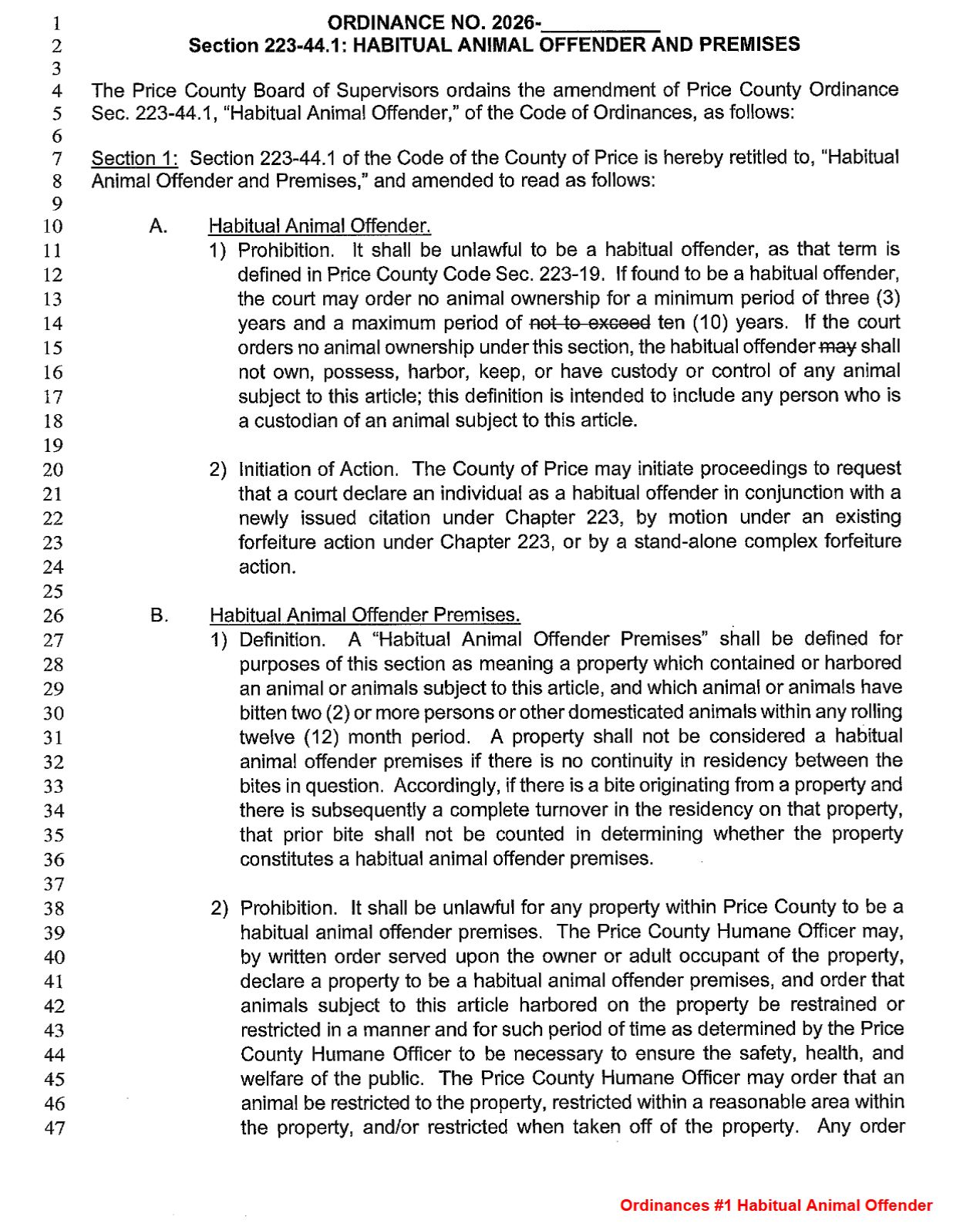
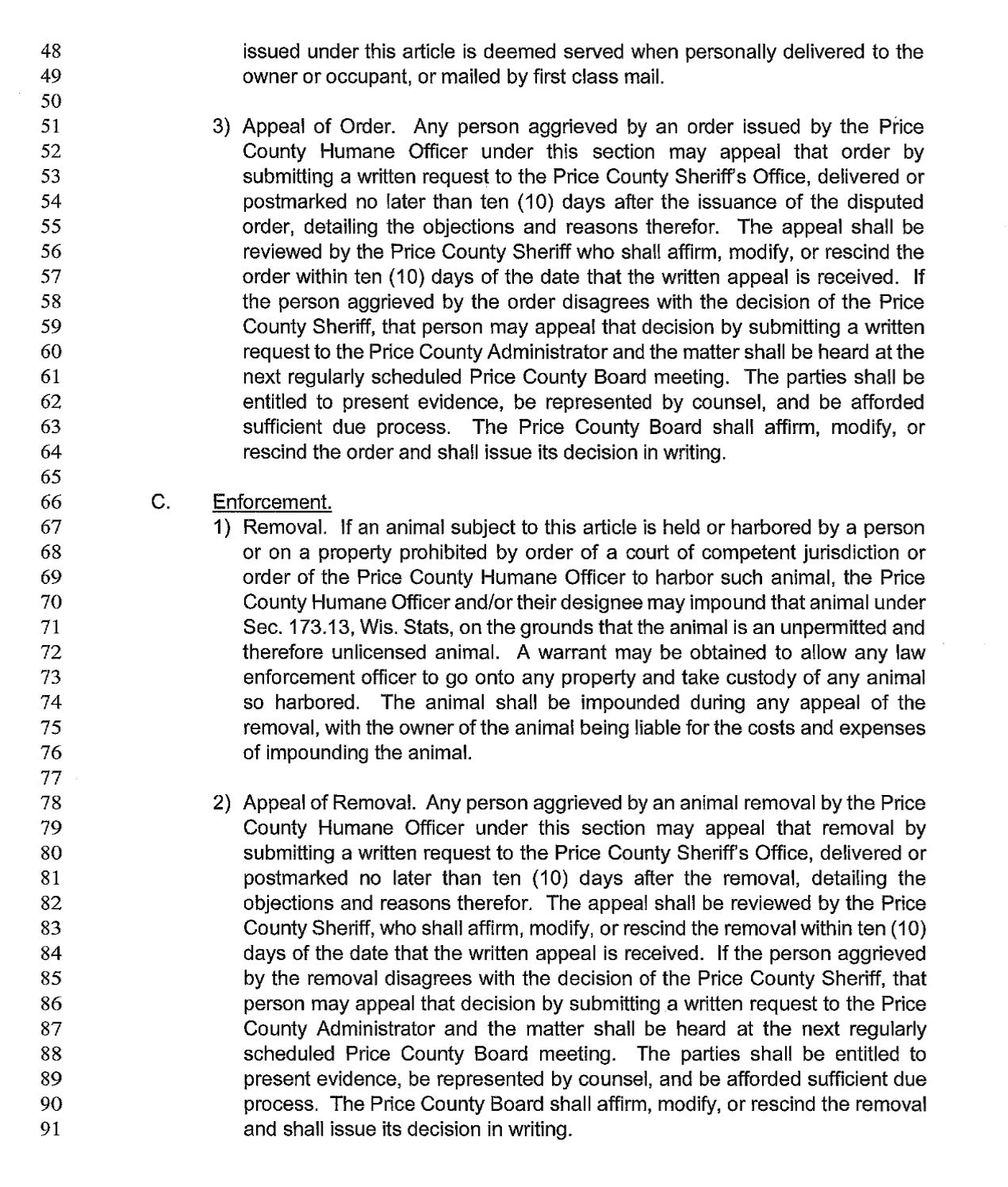
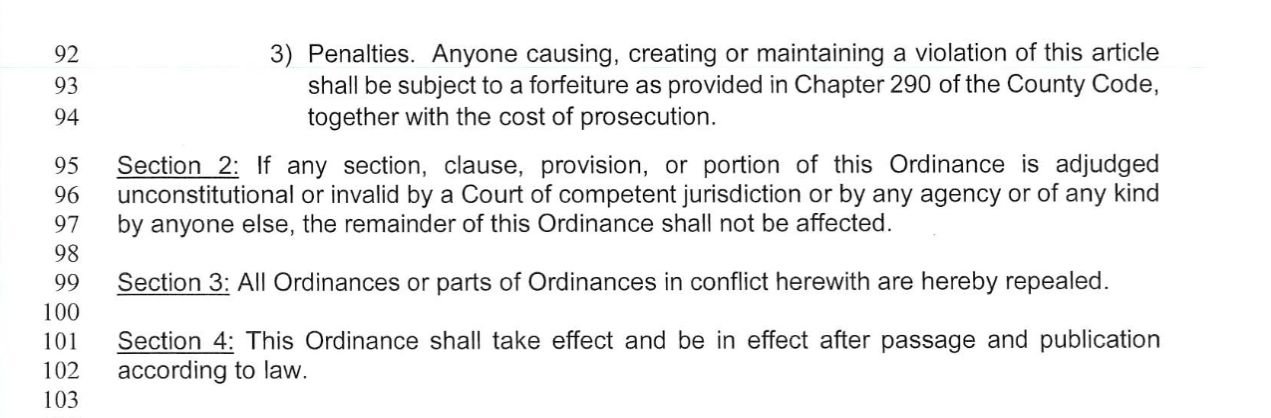
On May 9, 2026, two public hearings were held regarding the enactment of an animal biting ordinance and the definition of a "habitual offender."
During public comment, Ginny Strobl stated that sometimes neighbors don't get along and without requiring proof of bites, she feels someone could try to get a dog and neighbor in trouble for no actual reason. She felt a bite should need to be thoroughly checked by a medical professional to prove it occurred.
Walt Madsen stated that his main problem is that it opens it up as a red flag law for dogs. If a person has an issue with a neighbor, the neighbor could falsely report a neighbor's dog. He said he also has experience with a dog coming onto his property but could see how neighbors could use this to be problematic for one another. He felt it violated peoples' rights of life, liberty, and property. He felt it could be passed with some wording changes.
Sheriff Schmidt spoke and said it is not a red flag law at all.
Humane Officer Mindy Dabler gave more information on the topic. She said there were no animal-related complaints in 2023, three in 2024, and 20 in 2025. There was a large increase in 2025 due to particular owners who let two dogs breed, the male dog was hit by a car, and the female had three puppies. The owners purchased another dog, and the animals were allowed to run free as a pack. In 2025, 24 citations were issued to that residence. Twelve of the 20 total complaints involved incidents were chickens were allegedly killed on a neighboring property and dogs allegedly chased people (including a toddler), other dogs, and vehicles on the neighboring property. She felt that had the ordinance been in place at the time, ten complaints could have been prevented. She further stated that dangerous dog and vicious animal ordinances "track with the particular animal and require more than one bite or a severe attack by the same animal to take action." However, she stated, "a bite is not always an 'attack.' I would not consider any of the bites an 'attack' as none of the bites were severe; however, all of the bites broke the skin of the victims." One dog was removed from the home after its second bite, because the owners were not following the quarantine rules.
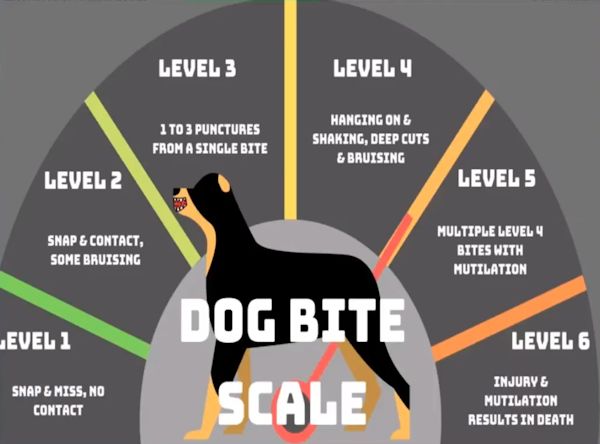
Image Credit: Price County Sheriff's Office
For Bite Levels 3 and above, quarantine orders are issued, so this ordinance would fit Levels 3 and higher.
Patty Stephan, a law enforcement committee member, asked, "How do we prove or confirm a bite?" Humane Officer Dabler said that mandatory reports usually come from medical professionals who are mandatory reporters.
Committee Member Dennis Wartgow said that during public comment he heard concerns that people may file a false complaint that a dog bit them. Sheriff Schmidt said there would be penalties for that. Obstructing charges would be sent to the district attorney, or a citation may be issued.
Amy Casey, the county coroner, was at the meeting and raised her hand with a question regarding the topic while Sheriff Schmidt was at the podium. He said, "You're not a committee member. You're not a committee member. Put your hand down. You're elected. Not a committee member." She said she just had a question and joked that she could arrest him. The chairman allowed her to speak, and she asked, "Is it still protocol to report dog bites to the public health department?" Mindy Dabler came back to the podium and replied that they are reported to her and to public health. "The quarantine orders are actually public health paperwork." Humane Officer Dabler said the police are the ones serving those papers to the people, then it goes to the health department, and she does follow-up if the people are not following the orders. She added that it's her job to make sure there is a correct report, and she has to see broken skin to accept it as a true dog bite report.
Committee Member Bob Kopisch said that there are a lot of "mays" and "shalls" in the wording. To him, "shall" means a person has to do it, so he questioned the wording. He also asked if it was typical for the entire board to make a decision on a habitual offender, and he felt involving thirteen members was a "slippery slope" which made him "uncomfortable." The reason he asked this is because a person accused of this would have a right to appeal to the board.
Patty Stephan asked where the animals go when they are removed. The humane officer said that they go to Catkins if they are adoptable. If they are not adoptable, meaning if they have bitten, then she has to make a decision and have the animal put down.
County Administrator Nick Trimner said this is less about taking of animals, which has always been something the humane officer can do, but this is more about the residence not being allowed to have animals at the residence, because some people who were not allowed to have animals would have an animal at their residence and claim it was owned by someone else. This ordinance would ban the residence from having animals for a specified time, unless someone else bought the property.
The Law Enforcement Committee voted to pass the ordinance with the presented wording amendment, striking "may" and replacing it with "shall." The motion was carried by all committee members.
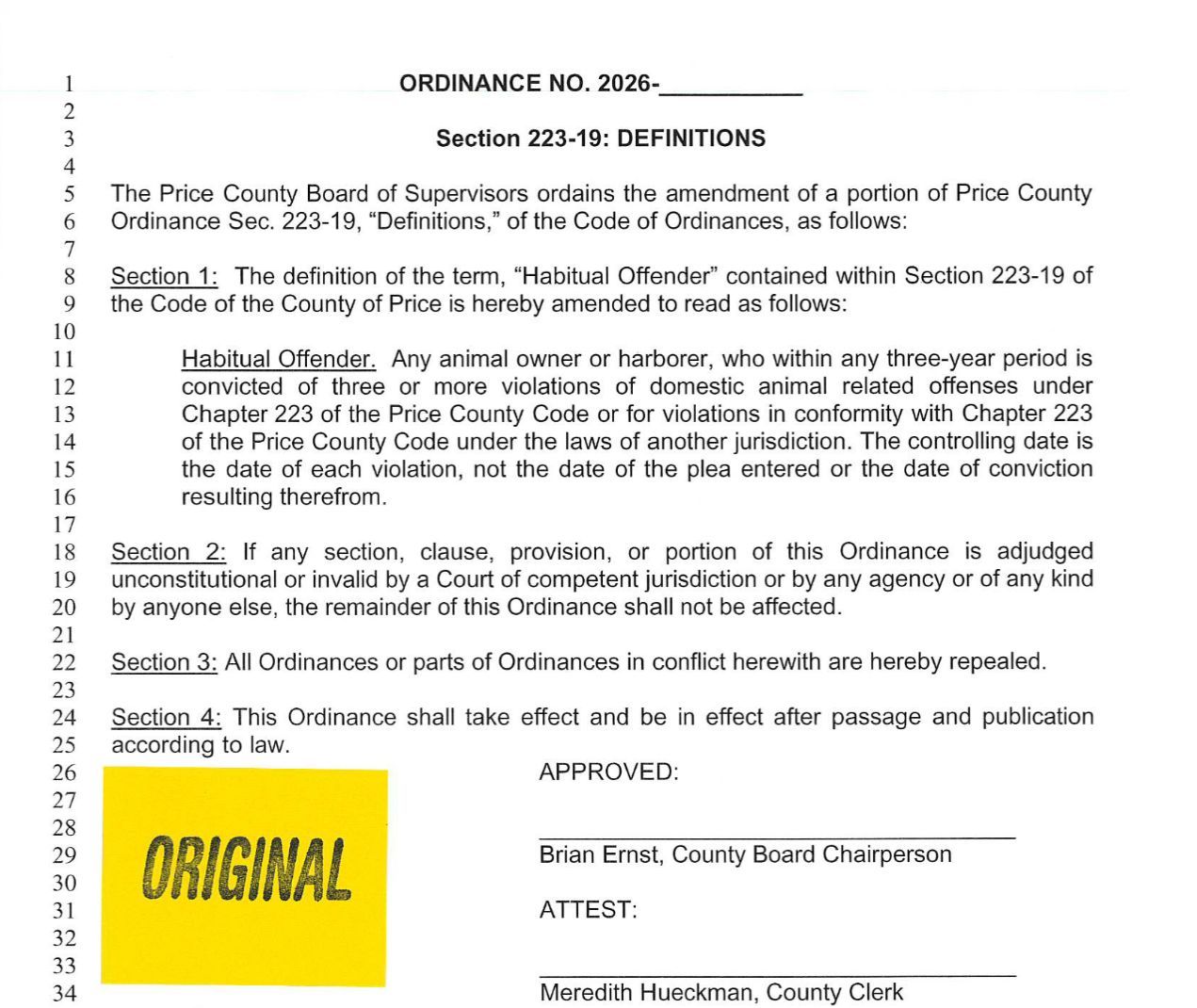
The definition of the term "habitual offender," referring to an animal owner or harborer, was also amended, and the motion carried by all committee members.
While Sheriff Schmidt and Humane Officer Dabler spoke of dogs during their presentation, since this ordinance states "animals," it appears it would apply to all animals that bite and would affect the ownership of all types of animals. Also, it is the "residence" (all people who live at that address even if they are not habitual offenders) that could be banned from animal ownership and not just a "resident." We asked Humane Officer Dabler for more information; however, our request for information was rather last minute on Monday morning. She stated she has a response ready but needs to get it approved and will likely be able to submit the answers to My Price County on Tuesday. However, that will likely be after the Common Council meeting, where this ordinance may get final approval. If you have questions or comments, the meeting is the morning of Tuesday, May 19, 2026. Public comment is allowed at the meeting for anyone interested in attending to voice an opinion. Otherwise, we will update this article when we have answers. The questions are as follows:
UPDATED 5-20-2026:
For the vicious animal biting ordinance, would all animals be counted for this, since it doesn't just state "dogs," such as cats, horses, etc.?
Humane Officer Dabler replied, "The current ordinances track with one particular animal. The new ordinance would allow for the county to track the bites pertaining to a specific address, not the specific animal. This is specifically meant for a residence with multiple residents with multiple animal owners and multiple animals.
"For your question about all animals being included, yes, to a reasonable degree. The likelihood of a farm animal creating a reason for this ordinance to be enforced is quite low and unlikely. I am required to issue quarantine orders for all cat, dog, and ferret bites, which occur in Price County. Most of the bites are reported by mandatory reporters, such as clinics and emergency rooms, when they are treating the patients for the bite wound."
If any animal habitually bites, are all animals covered in this ordinance? And does that mean that if a dog bites, then the residence cannot own a cat, for example?
Humane Officer Dabler replied, "The ordinance is not intended to handle one dog that bites. It is intended to address the cases with multiple different animal bites by different animals within a year. Yes, if convicted, it would mean they are not allowed to own ANY animals for the amount of time a judge orders them not to own animals."
And does the ordinance apply to anyone living at the residence?
Humane Officer Dabler replied, "Yes, it would apply to anyone living at the residence; however, once that person left that residence, this ordinance would no longer apply to them. It would be for the specific residence and anyone living there, unless everyone moved out and someone new moved in."
So, if a boyfriend and girlfriend moved in together, and the girlfriend could not have dogs at her residence due to being a habitual offender, does that mean the boyfriend could not have a dog at that residence?
Humane Officer Dabler replied, "With this question, please look at the information [definitions and ordinance information provided below] and understand that a Habitual Offender is different than a Habitual Animal Offender Premises.
"A Habitual Offender is convicted as an individual and the order prohibiting animal ownership follows them for the amount of time ordered.
"A Habitual Animal Offender Premises is specifically for a particular address.
"For your question, if the girlfriend is a Habitual Offender, the dog could not be at the residence if she were going to be owning, possessing, harboring, keeping or having custody or control of the dog.
"If the girlfriend’s prior residence was a Habitual Animal Offender Premises, but she moved in with the boyfriend at a different location, the dog could stay."
ORDINANCES AND DEFINITIONS PROVIDED BY HUMANE OFFICER DABLER:
§ 223-27 Vicious animals.
A.
The owner of any animal shall be in violation of this article if the animal engages in any activity or exhibits any behavior as defined by this article under "vicious animal" in § 223-19.
B.
Upon being adjudicated guilty of or entering a guilty plea or no contest plea to a charge made under this provision, the owner of the vicious animal, if allowed to maintain the animal, will have to adhere to the following requirements for possessing a vicious animal:
(1)
The owner must possess a proper enclosure to confine the vicious animal; and
(2)
The owner must post the premises with a vicious animal warning sign.
C.
Price County shall have the right to inspect, randomly and without notice, a vicious animal which is required to be confined pursuant to this section in its environment. Permission of the owner or person with custody of the animal confined shall not be unreasonably withheld.
D.
Any person who releases a vicious animal either willfully through failure to exercise due care or control or who takes such animal out of such proper enclosure in such a manner which is likely to cause injury to another person or damage to the property of another person shall be in violation of this article.
E.
For a conviction under this section refer to § 223-44 of this article.[1]
[1]
Editor's Note: Amended at time of adoption of Code (see Ch. 1, General Provisions, Art. II)
VICIOUS ANIMAL
A.
Any animal which:
(1)
Constitutes a physical threat to human beings or other animals by virtue of an attack of such severity or intensity as to cause severe property or physical damage;
(2)
Makes an unprovoked attack on animals or on human beings; or
(3)
Intentionally attacks physical property in an effort to cause harm to a human or other animal.
B.
An animal shall not be a vicious animal within the meaning of this article if:
(1)
It inflicts an injury upon a person when the animal is being used by a law enforcement officer carrying out official duties; or
(2)
The injury inflicted by the animal was sustained by a person who was committing a willful trespass or other tort; was tormenting, abusing or assaulting the animal; had in the past been reported to have tormented, abused or assaulted the animal; or was committing or attempting to commit a crime.
§ 223-25 Dangerous dogs.
[Amended 4-21-2015 by Ord. No. 1-15; 4-18-2023 by Ord. No. 2-23]
A.
It shall be unlawful for any person to have or possess a dangerous dog without notification to the Price County Sheriff's Office. "Dangerous dog" defined as such under § 223-19.
B.
Requirements of keeping dangerous dog.
(1)
A adequate structural strength enclosure to confine the dog from escape.
(2)
Posting on the premises of a dangerous dog a sign: "Warning. There is a dangerous dog on the property."
(3)
Annual license of the dog and paying an additional license fee for the dangerous dog.
C.
Right to inspect. The Price County Health and Human Services Department shall have the right to inspect, randomly and without notice, a dangerous dog which is required to be confined pursuant to this section in its environment. Permission of the owner or person with custody of the animal confined shall not be unreasonably withheld.
D.
Notice to County Sheriff's Department.
(1)
The owner of a dangerous dog shall notify the Price County Sheriff's Department within 24 hours if the dog is loose, unconfined, has attacked a human, has died, or has been sold or donated. If the dog has been sold or donated, the owner shall provide the Price County Health and Human Services Department with the name, address, and telephone number of the new owner of the dog and notify the new owner of the designation.
(2)
The owner of a dangerous dog shall notify the Price County Sheriff's Department within 10 days if the owner is moving within Price County's jurisdiction or out of the County.
E.
Violations. Any person who releases a dangerous dog either willfully through failure to exercise due care or control or who takes such animal out of such proper enclosure in such a manner which is likely to cause injury to another person or damage to the property of another person shall be in violation of this article.
DANGEROUS DOG
A.
Any dog that, according to the records of the County, has without provocation either inflicted body harm on a human being on public or private property or bitten, attacked or endangered the safety of humans after the dog has previously bitten others. The owner will be notified of such classification.
B.
A dog shall not be a dangerous dog within the meaning of this article if:
(1)
The dog inflicts an injury upon a person when the dog is being used by a law enforcement officer executing official duties.
(2)
The injury inflicted by the dog was sustained by a person who, at the time, was committing a willful trespass or other tort; was tormenting, abusing, or assaulting the dog; had in the past been reported to have tormented, abused or assaulted the dog; or was committing or attempting to commit a crime.
§ 223-44.1 Habitual animal offender.
[Added 4-18-2023 by Ord. No. 2-23]
It shall be unlawful to be a habitual offender. If found to be a habitual offender, the court may order no animal ownership for a minimum period of three years, not to exceed 10 years.
HABITUAL OFFENDER
Any animal owner or harborer, who within any three-year period is convicted of three or more violations of domestic animal related offenses under Chapter 223 of the Price County Code. The controlling date is the date of each violation, not the date of the plea entered or the date of conviction resulting therefrom.
[Added 4-18-2023 by Ord. No. 2-23]
ANIMAL BITE
Any physical contact of the teeth of the animal with human flesh, including but not limited to a puncture, pierce, scratch or tear.
OWNER
Any person owning, possessing, harboring, keeping or having custody or control of any animal subject to this article. This definition is intended to embrace any person who is a custodian.
(This post was last modified: 05-20-2026, 04:03 PM by My Northern Wisconsin.)
During public comment, Ginny Strobl stated that sometimes neighbors don't get along and without requiring proof of bites, she feels someone could try to get a dog and neighbor in trouble for no actual reason. She felt a bite should need to be thoroughly checked by a medical professional to prove it occurred.
Walt Madsen stated that his main problem is that it opens it up as a red flag law for dogs. If a person has an issue with a neighbor, the neighbor could falsely report a neighbor's dog. He said he also has experience with a dog coming onto his property but could see how neighbors could use this to be problematic for one another. He felt it violated peoples' rights of life, liberty, and property. He felt it could be passed with some wording changes.
Sheriff Schmidt spoke and said it is not a red flag law at all.
Humane Officer Mindy Dabler gave more information on the topic. She said there were no animal-related complaints in 2023, three in 2024, and 20 in 2025. There was a large increase in 2025 due to particular owners who let two dogs breed, the male dog was hit by a car, and the female had three puppies. The owners purchased another dog, and the animals were allowed to run free as a pack. In 2025, 24 citations were issued to that residence. Twelve of the 20 total complaints involved incidents were chickens were allegedly killed on a neighboring property and dogs allegedly chased people (including a toddler), other dogs, and vehicles on the neighboring property. She felt that had the ordinance been in place at the time, ten complaints could have been prevented. She further stated that dangerous dog and vicious animal ordinances "track with the particular animal and require more than one bite or a severe attack by the same animal to take action." However, she stated, "a bite is not always an 'attack.' I would not consider any of the bites an 'attack' as none of the bites were severe; however, all of the bites broke the skin of the victims." One dog was removed from the home after its second bite, because the owners were not following the quarantine rules.
Image Credit: Price County Sheriff's Office
For Bite Levels 3 and above, quarantine orders are issued, so this ordinance would fit Levels 3 and higher.
Patty Stephan, a law enforcement committee member, asked, "How do we prove or confirm a bite?" Humane Officer Dabler said that mandatory reports usually come from medical professionals who are mandatory reporters.
Committee Member Dennis Wartgow said that during public comment he heard concerns that people may file a false complaint that a dog bit them. Sheriff Schmidt said there would be penalties for that. Obstructing charges would be sent to the district attorney, or a citation may be issued.
Amy Casey, the county coroner, was at the meeting and raised her hand with a question regarding the topic while Sheriff Schmidt was at the podium. He said, "You're not a committee member. You're not a committee member. Put your hand down. You're elected. Not a committee member." She said she just had a question and joked that she could arrest him. The chairman allowed her to speak, and she asked, "Is it still protocol to report dog bites to the public health department?" Mindy Dabler came back to the podium and replied that they are reported to her and to public health. "The quarantine orders are actually public health paperwork." Humane Officer Dabler said the police are the ones serving those papers to the people, then it goes to the health department, and she does follow-up if the people are not following the orders. She added that it's her job to make sure there is a correct report, and she has to see broken skin to accept it as a true dog bite report.
Committee Member Bob Kopisch said that there are a lot of "mays" and "shalls" in the wording. To him, "shall" means a person has to do it, so he questioned the wording. He also asked if it was typical for the entire board to make a decision on a habitual offender, and he felt involving thirteen members was a "slippery slope" which made him "uncomfortable." The reason he asked this is because a person accused of this would have a right to appeal to the board.
Patty Stephan asked where the animals go when they are removed. The humane officer said that they go to Catkins if they are adoptable. If they are not adoptable, meaning if they have bitten, then she has to make a decision and have the animal put down.
County Administrator Nick Trimner said this is less about taking of animals, which has always been something the humane officer can do, but this is more about the residence not being allowed to have animals at the residence, because some people who were not allowed to have animals would have an animal at their residence and claim it was owned by someone else. This ordinance would ban the residence from having animals for a specified time, unless someone else bought the property.
The Law Enforcement Committee voted to pass the ordinance with the presented wording amendment, striking "may" and replacing it with "shall." The motion was carried by all committee members.
The definition of the term "habitual offender," referring to an animal owner or harborer, was also amended, and the motion carried by all committee members.
While Sheriff Schmidt and Humane Officer Dabler spoke of dogs during their presentation, since this ordinance states "animals," it appears it would apply to all animals that bite and would affect the ownership of all types of animals. Also, it is the "residence" (all people who live at that address even if they are not habitual offenders) that could be banned from animal ownership and not just a "resident." We asked Humane Officer Dabler for more information; however, our request for information was rather last minute on Monday morning. She stated she has a response ready but needs to get it approved and will likely be able to submit the answers to My Price County on Tuesday. However, that will likely be after the Common Council meeting, where this ordinance may get final approval. If you have questions or comments, the meeting is the morning of Tuesday, May 19, 2026. Public comment is allowed at the meeting for anyone interested in attending to voice an opinion. Otherwise, we will update this article when we have answers. The questions are as follows:
UPDATED 5-20-2026:
For the vicious animal biting ordinance, would all animals be counted for this, since it doesn't just state "dogs," such as cats, horses, etc.?
Humane Officer Dabler replied, "The current ordinances track with one particular animal. The new ordinance would allow for the county to track the bites pertaining to a specific address, not the specific animal. This is specifically meant for a residence with multiple residents with multiple animal owners and multiple animals.
"For your question about all animals being included, yes, to a reasonable degree. The likelihood of a farm animal creating a reason for this ordinance to be enforced is quite low and unlikely. I am required to issue quarantine orders for all cat, dog, and ferret bites, which occur in Price County. Most of the bites are reported by mandatory reporters, such as clinics and emergency rooms, when they are treating the patients for the bite wound."
If any animal habitually bites, are all animals covered in this ordinance? And does that mean that if a dog bites, then the residence cannot own a cat, for example?
Humane Officer Dabler replied, "The ordinance is not intended to handle one dog that bites. It is intended to address the cases with multiple different animal bites by different animals within a year. Yes, if convicted, it would mean they are not allowed to own ANY animals for the amount of time a judge orders them not to own animals."
And does the ordinance apply to anyone living at the residence?
Humane Officer Dabler replied, "Yes, it would apply to anyone living at the residence; however, once that person left that residence, this ordinance would no longer apply to them. It would be for the specific residence and anyone living there, unless everyone moved out and someone new moved in."
So, if a boyfriend and girlfriend moved in together, and the girlfriend could not have dogs at her residence due to being a habitual offender, does that mean the boyfriend could not have a dog at that residence?
Humane Officer Dabler replied, "With this question, please look at the information [definitions and ordinance information provided below] and understand that a Habitual Offender is different than a Habitual Animal Offender Premises.
"A Habitual Offender is convicted as an individual and the order prohibiting animal ownership follows them for the amount of time ordered.
"A Habitual Animal Offender Premises is specifically for a particular address.
"For your question, if the girlfriend is a Habitual Offender, the dog could not be at the residence if she were going to be owning, possessing, harboring, keeping or having custody or control of the dog.
"If the girlfriend’s prior residence was a Habitual Animal Offender Premises, but she moved in with the boyfriend at a different location, the dog could stay."
ORDINANCES AND DEFINITIONS PROVIDED BY HUMANE OFFICER DABLER:
§ 223-27 Vicious animals.
A.
The owner of any animal shall be in violation of this article if the animal engages in any activity or exhibits any behavior as defined by this article under "vicious animal" in § 223-19.
B.
Upon being adjudicated guilty of or entering a guilty plea or no contest plea to a charge made under this provision, the owner of the vicious animal, if allowed to maintain the animal, will have to adhere to the following requirements for possessing a vicious animal:
(1)
The owner must possess a proper enclosure to confine the vicious animal; and
(2)
The owner must post the premises with a vicious animal warning sign.
C.
Price County shall have the right to inspect, randomly and without notice, a vicious animal which is required to be confined pursuant to this section in its environment. Permission of the owner or person with custody of the animal confined shall not be unreasonably withheld.
D.
Any person who releases a vicious animal either willfully through failure to exercise due care or control or who takes such animal out of such proper enclosure in such a manner which is likely to cause injury to another person or damage to the property of another person shall be in violation of this article.
E.
For a conviction under this section refer to § 223-44 of this article.[1]
[1]
Editor's Note: Amended at time of adoption of Code (see Ch. 1, General Provisions, Art. II)
VICIOUS ANIMAL
A.
Any animal which:
(1)
Constitutes a physical threat to human beings or other animals by virtue of an attack of such severity or intensity as to cause severe property or physical damage;
(2)
Makes an unprovoked attack on animals or on human beings; or
(3)
Intentionally attacks physical property in an effort to cause harm to a human or other animal.
B.
An animal shall not be a vicious animal within the meaning of this article if:
(1)
It inflicts an injury upon a person when the animal is being used by a law enforcement officer carrying out official duties; or
(2)
The injury inflicted by the animal was sustained by a person who was committing a willful trespass or other tort; was tormenting, abusing or assaulting the animal; had in the past been reported to have tormented, abused or assaulted the animal; or was committing or attempting to commit a crime.
§ 223-25 Dangerous dogs.
[Amended 4-21-2015 by Ord. No. 1-15; 4-18-2023 by Ord. No. 2-23]
A.
It shall be unlawful for any person to have or possess a dangerous dog without notification to the Price County Sheriff's Office. "Dangerous dog" defined as such under § 223-19.
B.
Requirements of keeping dangerous dog.
(1)
A adequate structural strength enclosure to confine the dog from escape.
(2)
Posting on the premises of a dangerous dog a sign: "Warning. There is a dangerous dog on the property."
(3)
Annual license of the dog and paying an additional license fee for the dangerous dog.
C.
Right to inspect. The Price County Health and Human Services Department shall have the right to inspect, randomly and without notice, a dangerous dog which is required to be confined pursuant to this section in its environment. Permission of the owner or person with custody of the animal confined shall not be unreasonably withheld.
D.
Notice to County Sheriff's Department.
(1)
The owner of a dangerous dog shall notify the Price County Sheriff's Department within 24 hours if the dog is loose, unconfined, has attacked a human, has died, or has been sold or donated. If the dog has been sold or donated, the owner shall provide the Price County Health and Human Services Department with the name, address, and telephone number of the new owner of the dog and notify the new owner of the designation.
(2)
The owner of a dangerous dog shall notify the Price County Sheriff's Department within 10 days if the owner is moving within Price County's jurisdiction or out of the County.
E.
Violations. Any person who releases a dangerous dog either willfully through failure to exercise due care or control or who takes such animal out of such proper enclosure in such a manner which is likely to cause injury to another person or damage to the property of another person shall be in violation of this article.
DANGEROUS DOG
A.
Any dog that, according to the records of the County, has without provocation either inflicted body harm on a human being on public or private property or bitten, attacked or endangered the safety of humans after the dog has previously bitten others. The owner will be notified of such classification.
B.
A dog shall not be a dangerous dog within the meaning of this article if:
(1)
The dog inflicts an injury upon a person when the dog is being used by a law enforcement officer executing official duties.
(2)
The injury inflicted by the dog was sustained by a person who, at the time, was committing a willful trespass or other tort; was tormenting, abusing, or assaulting the dog; had in the past been reported to have tormented, abused or assaulted the dog; or was committing or attempting to commit a crime.
§ 223-44.1 Habitual animal offender.
[Added 4-18-2023 by Ord. No. 2-23]
It shall be unlawful to be a habitual offender. If found to be a habitual offender, the court may order no animal ownership for a minimum period of three years, not to exceed 10 years.
HABITUAL OFFENDER
Any animal owner or harborer, who within any three-year period is convicted of three or more violations of domestic animal related offenses under Chapter 223 of the Price County Code. The controlling date is the date of each violation, not the date of the plea entered or the date of conviction resulting therefrom.
[Added 4-18-2023 by Ord. No. 2-23]
ANIMAL BITE
Any physical contact of the teeth of the animal with human flesh, including but not limited to a puncture, pierce, scratch or tear.
OWNER
Any person owning, possessing, harboring, keeping or having custody or control of any animal subject to this article. This definition is intended to embrace any person who is a custodian.